
Hear customers in their own language

Share a link or a QR code. Your customers answer on video, on their own phone, and you get transcripts, themes and sentiment within minutes.

Languages

Answers in 23 languages, every scheduled Indian language and English, transcribed as they were spoken.

  • Assamese
  • Bengali
  • Bodo
  • Dogri
  • English
  • Gujarati
  • Hindi
  • Kannada
  • Kashmiri
  • Konkani
  • Maithili
  • Malayalam
  • Manipuri
  • Marathi
  • Nepali
  • Odia
  • Punjabi
  • Sanskrit
  • Santali
  • Sindhi
  • Tamil
  • Telugu
  • Urdu

Book a demo

A 30-minute tour

We will take you through a survey from the first question to the findings, and talk through what you want to learn.

Monday to Friday, 10:00–13:00 and 16:00–20:00 IST

Email us instead

Loading the booking calendar…

Features

From question to finding, without the sorting

Write a few open questions and share the survey. Each video answer comes back transcribed with timestamps, tagged by theme and marked positive, neutral or negative, so the reading and sorting is done before you open the dashboard.

Capture

Answers in their own words

People open a link or scan a QR code, and record their answer on the phone already in their hand.

There is nothing to install and no account to create: a few details, a consent screen, then the camera. Recording quality adjusts to the connection, and the audio is kept clear, because the transcript depends on it.

Answers can run to three minutes each, and one that is interrupted by a dropped connection is not lost.

For the people answering

  • No app to install, no account to create.
  • Any of 23 languages, transcribed as spoken.
  • Asked for consent before the camera turns on.
  • A dropped connection doesn't lose the answer.
Request a survey

Insights

Every answer, already sorted

As answers arrive, each recording is transcribed with timestamps, and each spoken or typed answer is tagged with the themes it touches.

The overview brings those themes together for the whole survey: how many responses raised each one, and whether people spoke about it positively, neutrally or negatively. Open any response to watch it beside its timed transcript. Choices, scales and numbers get a chart each.

Filter by gender, age or the date an answer was recorded, and rate the answers worth coming back to.

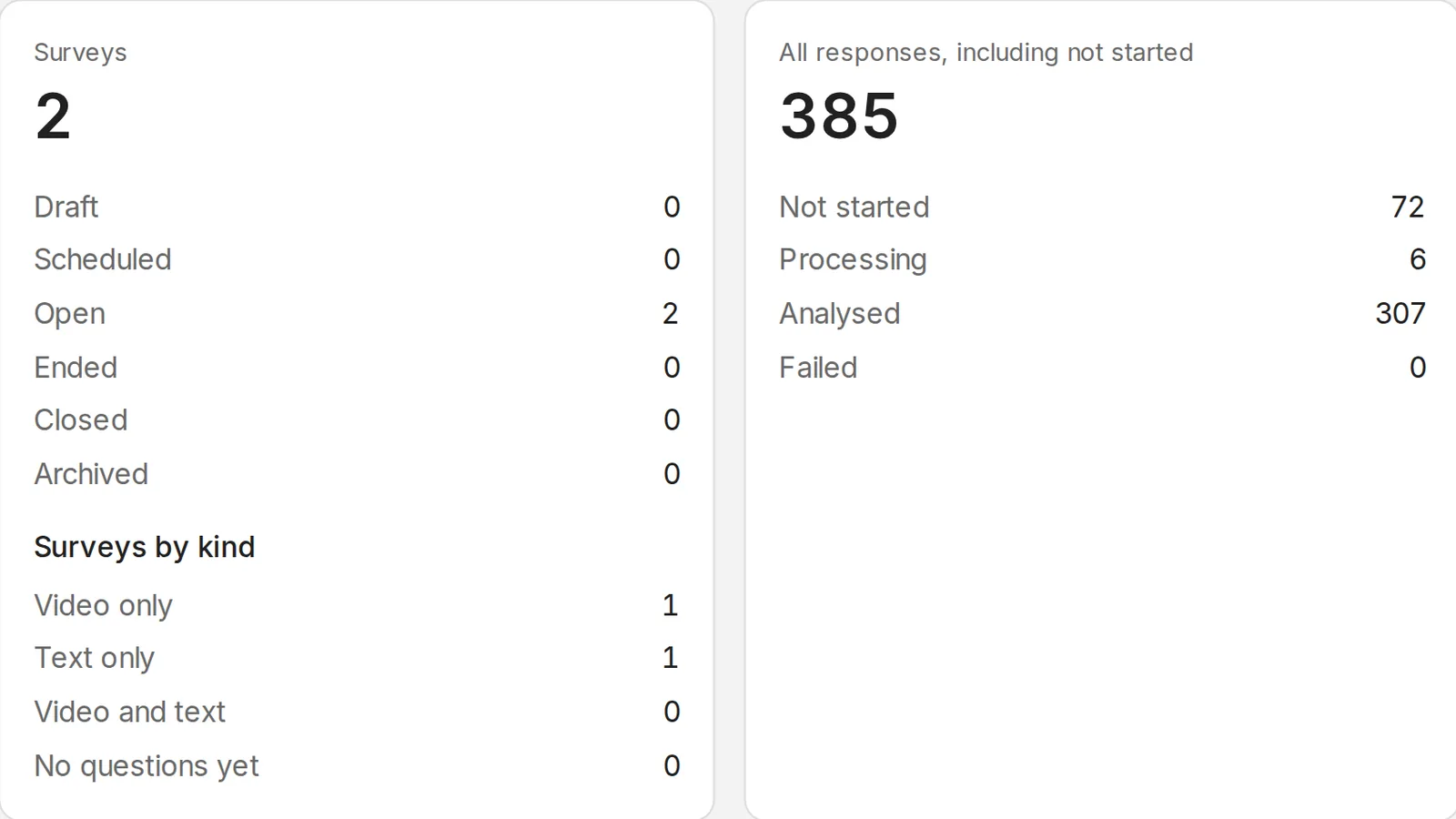
The dashboard home's survey and response counts: surveys by phase and by kind (2 surveys, both open; 1 video only and 1 text only), and all responses by status (385 in all: 72 not started, 6 processing, 307 analysed, 0 failed). Example data.

In the dashboard

  • A timed transcript for every recording.
  • Themes with positive, neutral and negative splits.
  • A word cloud drawn from the survey's themes.
  • A spreadsheet of every answer, and share links that expire.
  • How far people got without sending, question by question.
See the product

Languages

Heard in the language they think in

People tend to say more, and say it more exactly, in the language they are most at home in. So they can answer in any of 23 languages, and each answer is transcribed in the language it was spoken.

Example questions

Questions that open people up

Video works best with open questions. Here are a few we would start with. They are examples, not quotes from customers.

Read the guides

“What did you expect before you tried it, and what surprised you?”

Product trialExample question

“Think of the last time you chose us over someone else. What decided it?”

Brand perceptionExample question

“Tell us about the moment it went wrong. What would have put it right?”

Customer experienceExample question

Why video

When a voice says more

A typed answer or a choice tells you what people think. A spoken answer adds the reason, the tone and the story behind it. Ask each kind where it fits, in the same survey.

A typed answer

  • Typed:A choice or a score, without the reason behind it.
  • Typed:A few words, typed in a hurry.
  • Typed:Harder for anyone who doesn't write easily.
  • Typed:Quick to give, but rarely the whole story.

A spoken answer

  • Spoken:The reason, in their own words and voice.
  • Spoken:Tone and expression you can watch for yourself.
  • Spoken:Open to anyone who can speak, in 23 languages.
  • Spoken:Transcribed and grouped by theme for you.